

What goes in a family game night gift basket?
Every good basket follows the same 1-2-3 formula: one anchor game, two or three fillers, and snacks plus something to keep score. The anchor is the box people will actually open first, so pick a crowd-pleaser that plays in under an hour with four or more players. Fillers are small, fast games or single decks that fit in one hand. Snacks and a scorepad with pencils tie it together and get used every round.
Match the anchor to the occasion. A birthday basket for adults can lean into trivia and party games; a basket for a family reunion needs a game that toddlers and teenagers can share. If the group likes making up its own questions, add a card pointing to some quiz question ideas so the host can run a round with no preparation.
How do you build a game night basket on a $25, $50 or $100 budget?
Spend on the anchor game first, then pad with extras. These splits assume everyday shop prices; a premium anchor game moves everything up a tier.
Whatever the budget, keep every item usable in one evening. A $100 basket is not three times the games: it is the whole night, from the leaderboard to the prizes.
| Budget | Games | Extras | Snacks |
|---|---|---|---|
| $25 | One compact card, dice or party game ($10–15) | A scorepad and pencil | Two shareable bags, such as popcorn and chocolate ($5–8) |
| $50 | A quick party game and a longer trivia or round-based game | A sand timer, a small trophy or medal, and tie-breaker questions written on index cards | About $10 of sealed snacks |
| $100 | Two or three games ($50–60) | A whiteboard leaderboard with markers, a bell, and prizes for first, second and last place | Better snacks and drinks ($15–20) |
Which games work for a basket spanning toddlers to teens?
Anchor the basket with one game the whole group can play together, then layer age-specific fillers around it. Baskets fail when every item is a middle-ground compromise that nobody loves.
One shared anchor
Choose a game where reading is not the skill, such as a symbol-matching game like Spot It! (sold as Dobble outside North America). Keep rounds under about fifteen minutes: mixed-age groups lose the youngest players first.
Fillers by age band
A deck of cards and a printed cheat sheet for Go Fish covers children from about four. Uno and Sushi Go! suit roughly seven or eight and up. A bluffing or word game keeps teenagers at the table.
After the children’s bedtime
Add one adults-only deck or a party game such as Codenames for later in the evening. A picture round works across ages too: children guess the picture, adults guess the year.
How does a game night raffle basket differ from a gift basket?
A gift basket is built for someone you know; a raffle basket has to tempt strangers into buying tickets from across the room. Display value beats personal taste, broad appeal beats niche picks, and nothing perishable or fragile goes in, because the basket may sit on a table for hours. Pick one theme so it reads as a single prize, not a pile.
A workable raffle version of the $50 basket: a crate, a family card game with a wide age range, a book of quiz questions, popcorn, chocolate bars, a scorepad, pens and a small timer. Then present it so it sells itself:
- Build height: prop the main game on a box so it sits above the snacks.
- Tape the item list to the front so buyers see the full value at a glance.
- Put the theme on a folded card, such as “Family game night for six”.
- Leave out anything that melts, leaks or needs explaining.
What non-game extras belong in the basket?
The extras turn a pile of games into a ready-to-run night: snacks that survive the trip, a scorepad, pencils and a timer.
Pick sealed, single-serve snacks: popcorn bags, pretzels, chocolate buttons and drinks with lids. Avoid anything powdery, greasy or crumbly, because greasy fingers ruin cards, boards and phone screens mid-round. In a mixed-age basket, add one allergen-friendly option so nobody is left out.
Add a small lined scorepad, four pencils with erasers and a sand timer or kitchen timer for timed rounds and tie-breakers. A phone works, but a dedicated timer stops the night stalling while someone looks for theirs.

How should you package and present the basket?
Match the container to the occasion, and check that it holds a stack of boxed games without bowing.
Choose the container
A woven basket or wooden crate suits a family event, a metal tub a casual night in, and a sturdy gift bag anything you are carrying to someone else’s home.
Arrange it for the opening
Tall boxes at the back, small items in front and the anchor game in the centre at eye level. Nothing should hide behind anything else.
Wrap loosely, if at all
Clear cellophane looks shop-ready but crumples in transit and buries the contents. Wrap it loosely for the journey and untie it on arrival.
Add a running order
A ribbon and a handwritten list of rounds tied to the handle, such as “picture round, music round, tie-breaker”, makes it feel like a planned night before anyone opens a box. The quiz night running order has a template.

What should you avoid putting in a family game night basket?
Most basket mistakes are things that stop the games being played that evening.
- Messy snacks: powdered sweets, crumbly biscuits and loose chocolate that melts onto cards.
- Games with a long setup or a thick rulebook. If it needs fifteen minutes of explanation before the first laugh, it stays in the box.
- Small parts in a basket for a home with children under three. Check the age label on every game: in the US, the Consumer Product Safety Commission bans small parts in products for that age as a choking hazard.
- Anything that only works after the recipient signs up for a paid subscription.
Can you add a digital quiz to a physical basket?
Yes. Print a card with a QR code and one line of instructions, tuck it into the basket, and the recipient has a quiz ready for after the board games. Write the occasion on the card, such as “Happy 30th: the quiz starts at 8”, because a code with no context gets forgotten in a drawer.
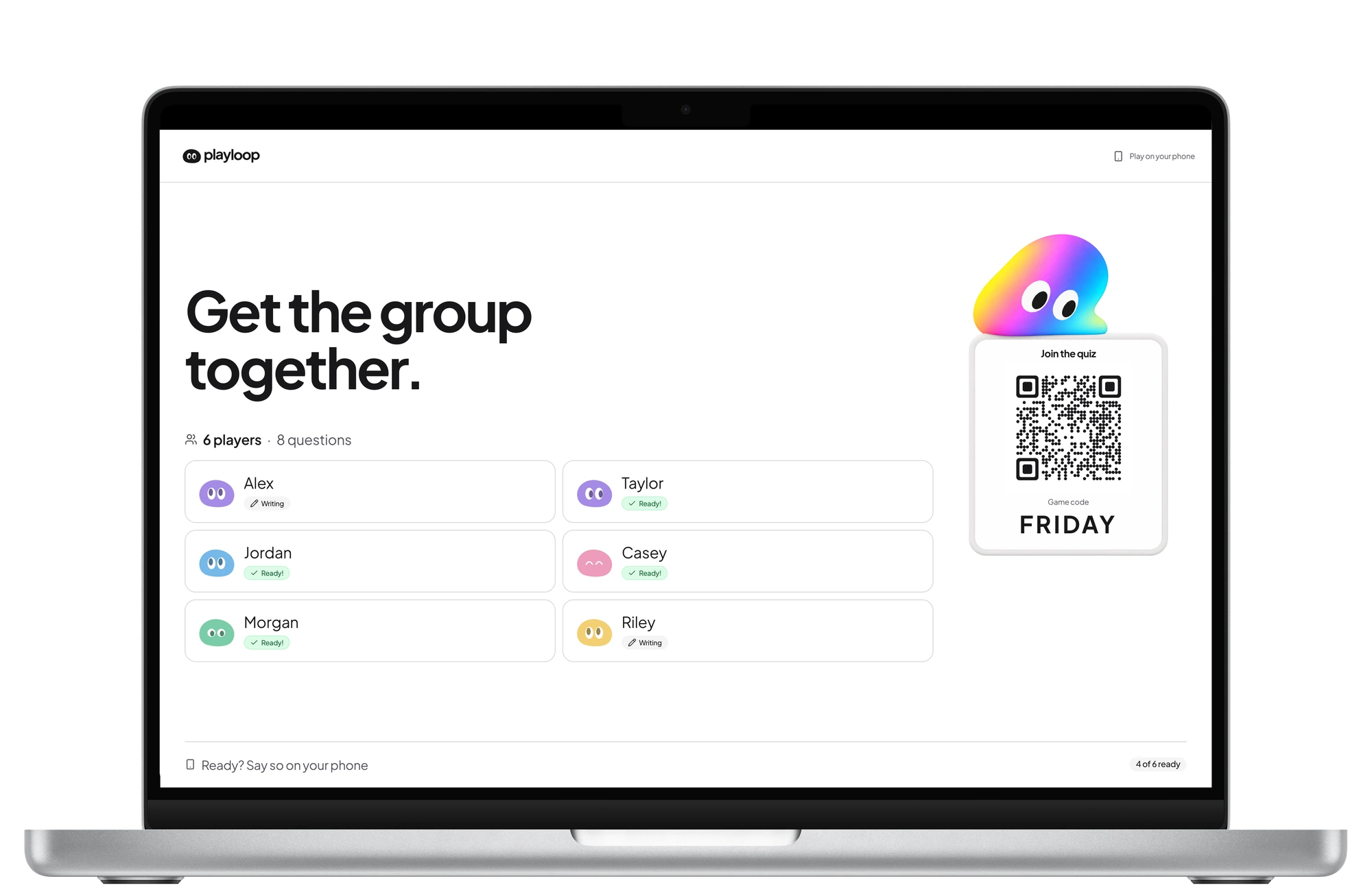
Point the code at a ready-made quiz such as Table talk, or at a quiz you set up for the group. With Playloop, everyone plays in the browser on their own phone with no app to install, friends can add their own questions before the night, and the host plays along. Guests always play free.
Know the limits. It is a quiz, so it will not replace bluffing or drawing games; scores are kept for each player rather than each team; and everyone needs a phone signal or Wi-Fi. Keep a written tie-breaker in the basket as a backup.
Ready-made quizzes to try