

What images work best in a pub quiz picture round?
The best picture-round images are ones everyone in the room half-recognises but nobody can name instantly: a logo with its lettering removed, a famous face from an earlier decade, a skyline from an unusual angle, an everyday object shot in close-up. A themed block, such as book covers with the title cropped out, works the same way: familiar, but not free points.
Skip anything that fails on a small screen or a distant TV: dense maps, screenshots of small print and dark photos of obscure buildings. Check that the answer is not written somewhere in the picture.
| Staple | Why it works | Example prompt |
|---|---|---|
| Logos | Instantly familiar and easy to disguise | Name the brand from its logo with the lettering removed |
| Faces | Everyone has an opinion, so tables talk | Name the actor from a photo taken 30 years ago |
| Landmarks | Works for mixed ages and travellers | Which city is this skyline? |
| Close-ups | Familiar objects become a puzzle | What everyday object is this, zoomed right in? |
How do you add a literature block to a picture round?
A literature block is a run of three or four bookish pictures inside a broader round, rising in difficulty. Keep it to three or four slots: a room that leans towards sport or film switches off after two book covers in a row.
Book covers
Choose covers people have seen on a shelf or a film poster: one recent bestseller, one classic and one children’s book. Crop out the title so it is not a free point, and accept either the title or the author.
First lines as images
Set an opening line on a plain slide styled like a book page, such as “Call me Ishmael.” Ask for the book, with a bonus for the author. Two is plenty; any more turns the round into a reading test.
Author portraits
Faces are hard, so make these worth half a point or accept the surname alone. Mix eras and genders so one person’s reading taste does not decide the block.

How many pictures should a pub quiz picture round have?
Ten to fifteen. Ten keeps a party moving in about ten minutes; fifteen suits a proper pub quiz with marking breaks between rounds. Fewer than ten feels like a warm-up, and past twenty the phones come out.
A ten-picture sheet works in three blocks: four staples (logos, faces, landmarks), four from your themed block, such as the literature run above, and two stumpers at the end. The bookish friend and the sports fan each get a block to shine in, and tables argue between blocks, which is half the fun. For sizing the rest of the night, see how many quiz questions you need.
How do you balance difficulty across a picture round?
Sort every image into easy, middle or stumper before you write a single prompt. For ten pictures, aim for four easy, four middle and two stumpers; for a longer round, grow the middle tier, not the top. Then order them so teams never lose momentum: easy early, middle in the centre, stumpers last. The guide to balancing quiz difficulty covers the same idea for whole quizzes.
Easy
At least one person at every table should get it: a current logo, a famous face, a landmark from a postcard.
Middle
Needs a moment’s thought. Zoom in on a logo or face, or show a book cover without its title, to move an easy picture up a tier without replacing it.
Stumper
Show only a corner of the image, so a lucky guess still feels earned. It exists to break ties, not to embarrass anyone.
Where can hosts find images they are allowed to use?
The simplest habit: use photos you took yourself, or images whose licence allows reuse and editing, and note where each one came from. Picture rounds usually crop, zoom or blur, so check that the licence allows changes. This is practical guidance rather than legal advice; the rules differ between countries and tighten if you charge for entry.
- Wikimedia Commons holds public domain and freely licensed images. Each file page states its licence and how to credit it.
- Creative Commons BY allows changes as long as you credit the creator and say what you changed. “NoDerivatives” (ND) licences do not allow edited versions, so avoid them for cropped or blurred clues.
- Unsplash and Pexels use their own free licences, which allow editing. Read each site’s short list of restrictions.
- Skip watermarked stock images, current film stills and anything copied from a paid product.
How do you score and mark a picture round fairly?
Decide the rules before the night and read them out when the round starts, not after someone argues.
One point, with half points announced
One point per picture, half a point for a near miss such as the author’s surname without the book, and nothing for a vague guess.
Be generous on spelling
Accept phonetic spellings of names, especially authors. “Hemmingway” should still score.
Mark against a master key
Number every picture, keep a written answer key and read the answers aloud as you mark, so disputes happen on the spot rather than at the end.
Hold a tie-breaker back
Keep one closest-number question hidden, such as the year a landmark opened. The guide to quiz tie-breakers has fair rules.
How do you run a picture round without printing handouts?
Show the pictures on a TV or laptop one at a time, or send them to every player’s phone, and collect answers on phones instead of paper. Leave each picture up longer than feels necessary: phone screens are small and someone always sits at a bad angle.
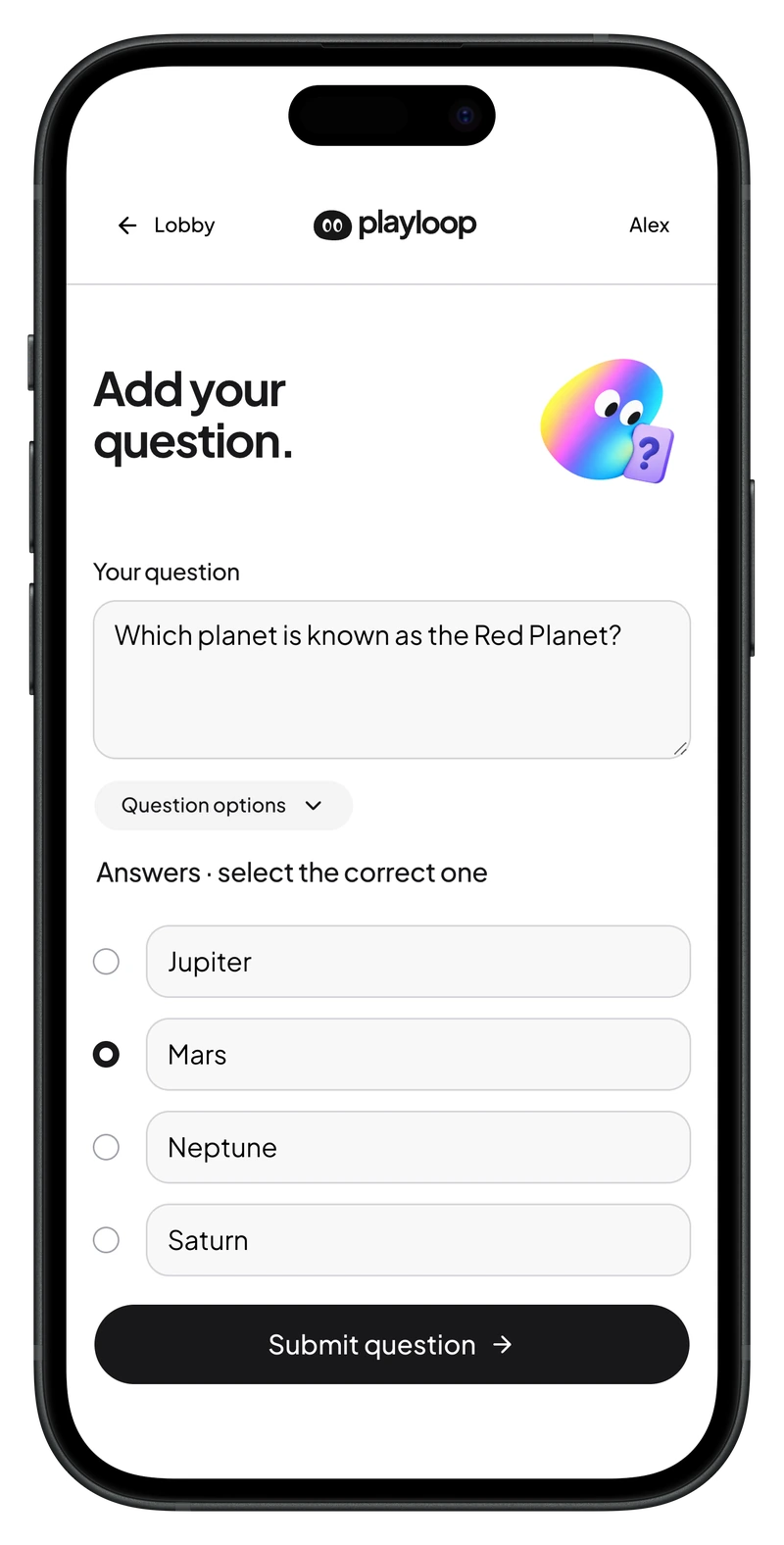
In Playloop, a question can carry images in the question and in the answer choices, so a picture round becomes single-choice: “Which city is this skyline?” with four cities to pick from. Choices end spelling arguments, the scores are kept for you, and friends can add their own picture questions privately before the night, so the host can play too. Scores are per player, so a team shares one phone.
The honest limits: everyone needs a connection, answer choices make a round a little easier than open answers, and if the Wi-Fi drops the round stops, so keep the images in a folder as a backup. The picture quiz checklist covers testing images on a phone first.
Ready-made quizzes to try