


How many questions make a good general knowledge round?
Ten. A ten-question round takes ten to fifteen minutes once you read the answers aloud and settle disputes. For a full night, plan 40 to 50 questions across four or five rounds, plus a tie-breaker round you hope not to use.
With 6 to 12 players, keep rounds at ten. With 20 or more, drop to eight a round so the night does not drag past two hours. If friends are sending questions, ask for them in batches of ten per round rather than one long list; the guide to collecting quiz questions walks through it.
Which general knowledge questions work as easy openers?
Openers should be answerable by every table within ten seconds. The first round builds confidence: a table that scores nothing on question one checks out for the rest of the night. Aim for the “oh, of course” reaction.
- How many minutes does a football (soccer) match last, not counting stoppage time?
- 90.
- Which planet is closest to the Sun?
- Mercury.
- What colour do you get by mixing blue and yellow paint?
- Green.
- How many strings does a standard guitar have?
- Six.
- In which city is the Eiffel Tower?
- Paris.
- What is the largest animal on Earth?
- The blue whale.
- How many legs does a spider have?
- Eight.
- Which fruit is most wine made from?
- Grapes.
- What does “www” stand for in a web address?
- World Wide Web.
- How many days are there in a leap year?
- 366.
What hard general knowledge questions keep a pub quiz competitive?
A hard round works when the answers are specific and checkable. These were checked against the sources at the end of this guide; check them again before the night, because facts such as capital names do change.
- Which planet has the shortest day, at under ten hours?
- Jupiter, which turns once in about 9.9 hours.
- What is the capital of Kazakhstan?
- Astana. It was called Nur-Sultan from 2019 to 2022, so decide in advance whether to accept the old name.
- Which artist painted The Garden of Earthly Delights?
- Hieronymus Bosch.
- In which year did the Berlin Wall fall?
- 1989.
- What is the chemical symbol for tungsten?
- W, from its other name, wolfram.
- Which country has the most time zones, counting its overseas territories?
- France, with 12.
- Who wrote the novel Atonement?
- Ian McEwan.
- What is the longest river entirely within Switzerland?
- The Aare, at about 295 km.
- Which gas makes up about 78% of Earth’s atmosphere?
- Nitrogen.
- In Greek myth, who answered the riddle of the Sphinx?
- Oedipus.

How do you balance the topics across rounds?
A fair round touches six areas: geography, history, science, sport, the arts and a miscellaneous slot. If the quiz leans on the host’s interests, the friend who never watches sport spends four questions in silence. Aim for one or two questions per area per round, and rotate which area opens and closes it.
This pack uses the mixed model. To swap a topic out, the quiz question ideas page has replacements by category, and the picture round guide covers the visual round.
| Structure | Best for | Watch out for |
|---|---|---|
| One topic per round | Pub quizzes with five or more rounds | Teams strong in one subject streak, then stall |
| Mixed topics every round | One-off game nights of two to four rounds | Needs a quick grid to avoid repeats |
| Picture round plus mixed rounds | Parties, hen and stag nights, family crowds | Preparing the pictures takes the most time |
What general knowledge questions make good tie-breakers?
Use closest-number questions with a single answer on record. Everyone writes a number, the nearest wins, and nobody can argue. Announce the format before the first one so teams know that precision matters more than speed.
If you run the quiz on phones, read these aloud and compare the guesses yourself: closest-number scoring is a house rule, not a game setting. The guide to quiz tie-breakers covers fair rules.
- How tall is the Eiffel Tower, in metres?
- 330 m, since a new antenna was added in 2022.
- In which year did Concorde first fly?
- 1969.
- How tall is Mount Everest, in metres?
- 8,849 m.
- How many bones are in the adult human body?
- 206.
- How many keys does a standard piano have?
- 88.
- How long is a marathon, in metres?
- 42,195 m.
How do you adapt the questions for mixed-ability teams?
Alternate easy, middle and hard questions within each round rather than between rounds. If every round ends on three hard questions, the strongest table banks its lead early and everyone else stops trying.
For a 40-question night, roughly half easy, a third middle and the rest hard keeps the leaderboard moving. If you mark on paper, make the hardest questions worth two points so a table that lands one can catch up. Difficulty is one person’s judgement, so skim the pack once and swap anything that feels wrong for your crowd. The guide to balancing quiz difficulty has more.
Which answers cause disputes, and how do you settle them?
Nearly every argument comes from spelling, dates or “which year” questions. Decide these before the night and announce them with the first round.
- A phonetic spelling of a name counts.
- Dates are accepted in any format.
- “Which year” questions get a stated window, such as one year either side, or none at all. Say which.
- Read the answer aloud, make one clear ruling and move on. Look at appeals at the break, not mid-round.
- If a dispute leaves two tables level, go to the tie-breaker.
How do you run the pack without hunching over a laptop?
On paper: print the pack, read the rounds aloud and mark the sheets yourself. It works, and plenty of quiz nights never use a screen. The cost is that you cannot play, and every disputed answer means flipping pages while the room waits.
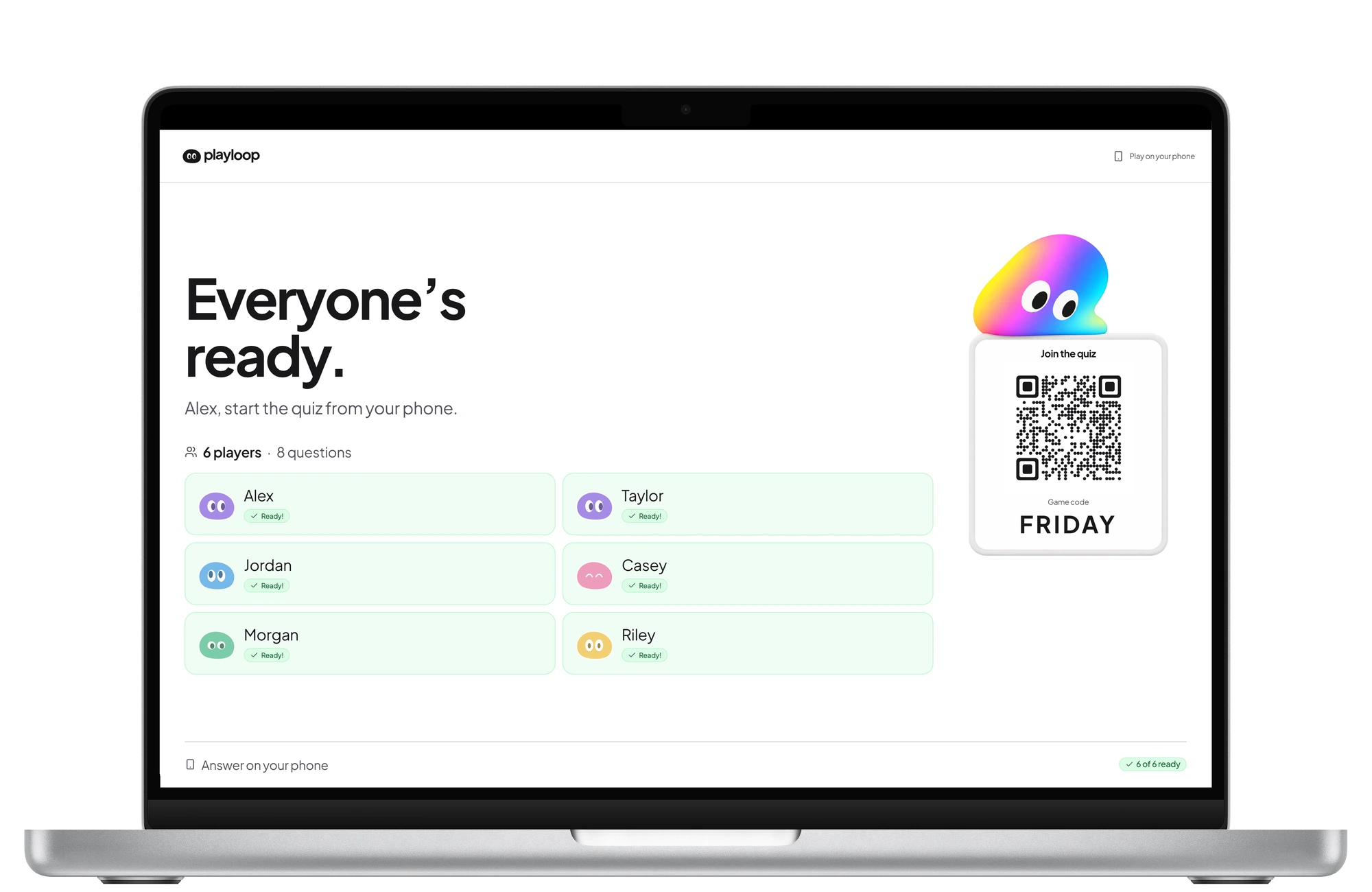
On phones: with Playloop, everyone joins in the browser with a game code, the questions appear on every phone and the scores are kept for you, so the host can play too. Give each question four answer choices and most spelling disputes disappear. You type the questions in yourself, or ask friends to add a few each before the night. Scores are per player, so a team shares one phone.
Ready-made quizzes to try