

What are good video game trivia questions with answers?
Every answer below was checked against the publisher, a museum or the record-keeper listed under Sources. Release dates differ by region, so the questions ask for things that do not: who, where and what came first.
- Before it made video games, Nintendo was founded in 1889 in Kyoto to make what?
- Hanafuda playing cards. Offer “playing cards”, “toys”, “board games” and “arcade cabinets” as choices.
- Which company first released Pac-Man in arcades in 1980?
- Namco, now part of Bandai Namco. It was first shown publicly in Tokyo in June 1980.
- Tetris was created in which city?
- Moscow, at the computing centre of the Soviet Academy of Sciences.
- Tetris got its name from “tetra”, meaning four, and which sport?
- Tennis, Alexey Pajitnov’s favourite. A good guessable question: half the room will get it from the sound alone.
- Counter-Strike started life as a fan-made mod for which game?
- Half-Life. Minh Le and Jess Cliffe released the first beta as a free mod in June 1999, and Valve hired them the following year.
- According to Guinness World Records, which is the best-selling single video game of all time?
- Minecraft. Ask for the game, not the sales figure, which keeps changing.
- Put these in release order: Pac-Man, Tetris, Counter-Strike, Minecraft.
- Pac-Man (1980), Tetris (1984), Counter-Strike (1999), Minecraft (2011). This works as an ordering question.
- Which Mojang game’s default player character is called Steve?
- Minecraft. Pair it with a picture of a blocky character you drew yourself rather than a screenshot.
- Deep cut from your group: which game did [friend] put the most hours into last year?
- Ask that friend to write it and confirm the answer from their own play history. Personal questions are the ones that start arguments in a good way.
- Deep cut from your group: which mod does [friend] refuse to play without?
- A natural fit for a group that swaps mod recommendations. Let the person who knows write the choices, so the wrong ones are plausible.
How hard should a video game round be?
Gaming groups are rarely even. One person has finished every release of the year; another only plays at parties. Pitch the round by who is in the room, then let the scores sort it out.
| Your group | What to ask | What to avoid |
|---|---|---|
| Mostly non-players | Famous characters, company origins, “which came first” puzzles | Patch notes, speedrun records, anything that needs a controller in hand |
| A mix | The 3-4-3 split, with picture questions of consoles and controllers | A whole round on one franchise only two people play |
| Regular gaming group | Mods, studios, soundtrack composers and questions about each other’s play | Live-service details that change every season |
How do you build the round with your group?
The best questions come from the people who play. Let each person add one or two before the night, then fill the gaps with the starters above.
Ask for one question each
Share an invite a few days ahead. In a collaborative quiz everyone writes privately, so nobody sees the questions until they are played, including the host.
Use the right question type
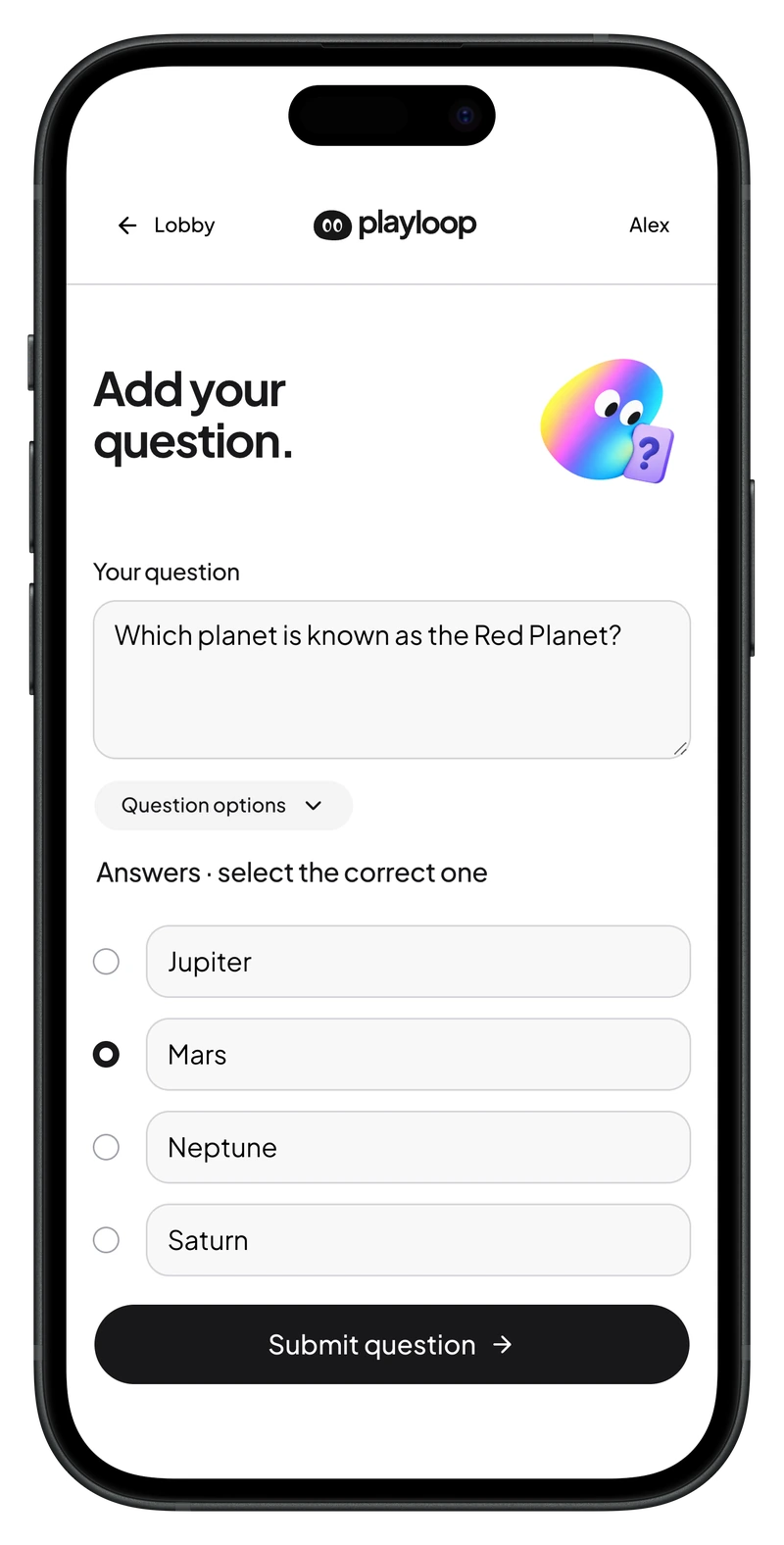
Single choice for most questions, ordering for release dates, a number with an accepted range for “how many copies” or “what year”, and a picture for a cropped piece of box art you made yourself.
Check anything with a number
Sales figures and player counts go stale fast. Ask for the record holder, not the total, or date the question: “as of April 2025”. The answer-checking guide has more.
Finish with guess who asked
After each contributed question, the group guesses who wrote it. In a gaming group that is half the fun: the person who asked about a 1990s shooter is rarely a mystery.
How do you do picture questions without copyright trouble?
Gamers love a zoomed-in screenshot round, but screenshots and box art belong to the publishers. For a private game with friends most people use them anyway; for anything public, stick to pictures you made.
- Photograph your own consoles, controllers and cartridges on the coffee table.
- Sketch a character’s silhouette and ask who it is.
- Describe a level in one sentence instead of showing it.
- Use a close-up picture round of hardware details, such as a button layout or a cartridge slot.
Ready-made quizzes to try